

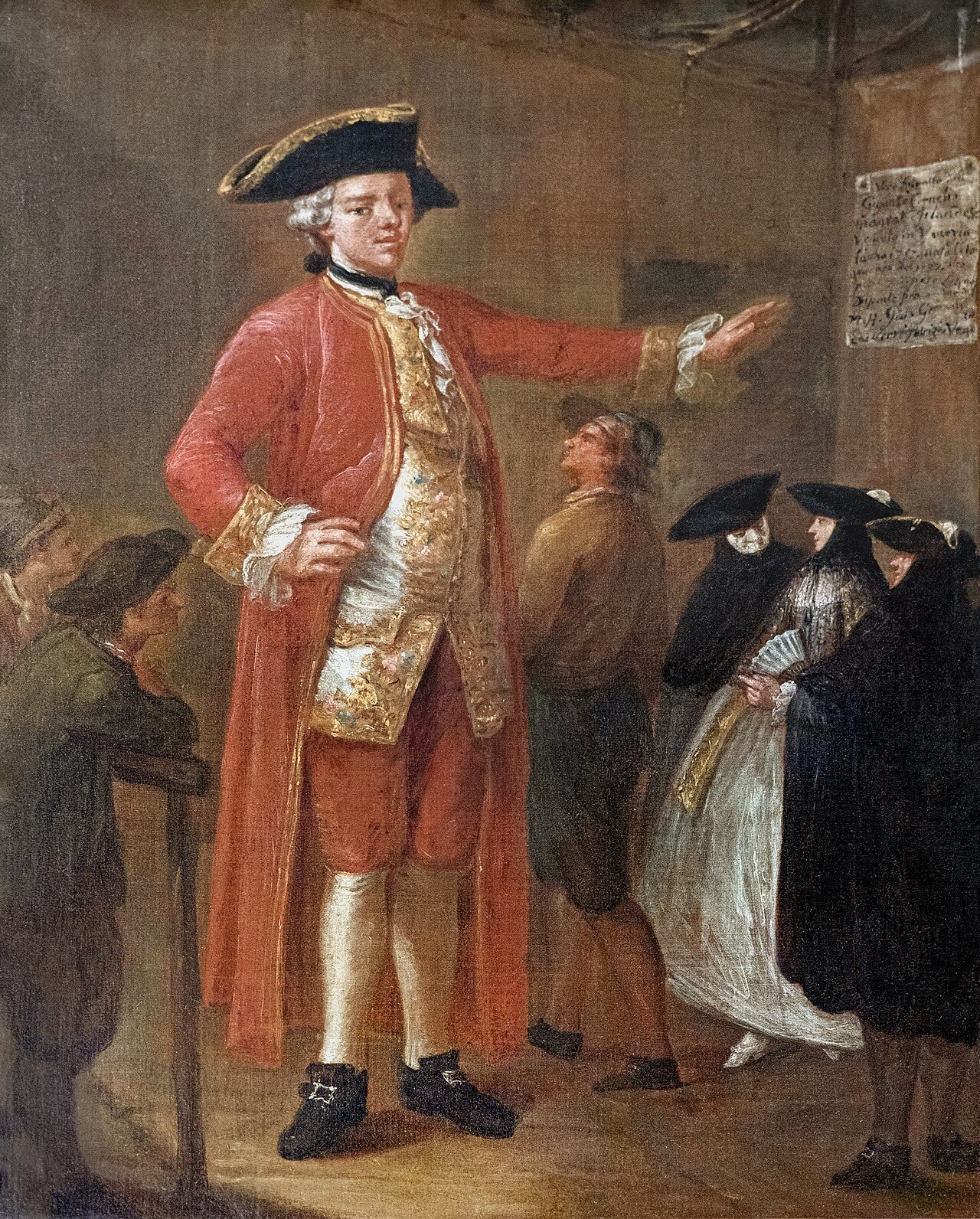
At Ca’ Rezzonico in Venice there’s another painting by Pietro Longhi.
A huge man in a red coat stands in the middle of a room. He raises his arm, and a man taller than average walks under it. He’s dressed as a gentleman: a tricorn hat, lace at the cuffs and buckles on his shoes.
A sheet pinned to the wall explains to visitors: “True Portrait of the Giant Cornelio Magrat the Irishman”.
Longhi painted it on commission from the patrician Giovanni Grimani dei Servi, the same man who had commissioned the rhinoceros six years earlier.
The boy’s name was Cornelius Magrath, born near Nenagh, in County Tipperary, in 1736 or 1737.
Until he was 11 he was a child like any other, then he started growing fast.
At 15 his legs began to hurt, so they sent him to Youghal, on the Cork coast, to bathe in the sea: they thought saltwater would heal him.
People crowded around this extraordinarily tall boy, until someone convinced him to exhibit himself for money.
From Youghal he went to Bristol, then London. In January 1753 his promoters ran an ad in the Daily Advertiser: the prodigy could be seen at the Peacock, at Charing Cross, “from eight in the morning till ten at night.”
Then Paris, and the great cities of the continent.
The signs changed the numbers at every stop. In 1752 the London Magazine gave him as 7 feet 9¾ inches (about 2.38 m); in London, the next year, 7 feet 3 inches (about 2.21 m), “the finest and best proportioned figure ever seen,” able to beat Cajanus the Swede, a rival giant already on the market.
They were sideshow numbers, inflated and never the same.
In Germany an engraving showed him well-built, straight-limbed, pleasant-featured, dressed in the fashion of the day: a fine big lad.
But that portrait was not truthful. More than a century later the bones showed it, at Trinity College: Cunningham (1891) described the deformities of the skull and the knock-knees; Swanzy (1894), studying the same skull, concluded that Magrath’s eyesight was probably failing.
Magrath had acromegaly, a disease medicine wouldn’t have a name for until 1886.
Longhi, though, painted what he saw. In the painting you can make out the uneven eye sockets and the crooked knees.
There’s only one measurement taken seriously while Magrath was alive. In Florence, in July 1757, the anatomist Giovanni Bianchi met him and measured him with a cord: 7 Parisian feet (about 2.26 m).
Bianchi noticed that everyone passed under his outstretched arms, the same gesture Longhi fixed on canvas. Then he wrote to a friend:
His conductors (…) should sometimes take him for a walk, especially by the sea, all the more because he was born in a maritime and cold country; but the desire for greater gain will perhaps cause them to lose all.
So, a contemporary saw the exploitation and wrote it down, back in 1757.
Bianchi understood something else too: the growth was a disease. He worked it out from the parents of ordinary height and the onset at 11, more than a century before doctors read it off the bones.
Magrath reached Venice that same year.
In a city of masks and merchants, a giant in the middle of a room drew a crowd. Longhi painted him and, as with the rhinoceros, he painted the people watching: the faces behind the masks, the poses.
In 1760 Magrath came back to Ireland with a fever he’d caught in Flanders. Already sick, he advertised himself again: at the Golden Ball in College Green, Dublin, “from nine in the morning till eight at night.”
Soon after, he stepped onto a stage. The Theatre Royal was running a pantomime, Jack the Giant-Killer. The part of the Giant, the bill said, was “performed by the REAL GIANT, being his only Appearance on any Stage.”
And sadly it was. On 16 May that year he died, not yet twenty-five.
A few days later, close by at Trinity College, they held the lecture on his dissection, “before a numerous audience.”
A Dublin obituary wrote that the skeleton, “on account of its extraordinary size, will amuse the curious and fill posterity with wonder.”
Cornelius Magrath’s skeleton is still at Trinity College. In 2011 it was displayed for the 300th anniversary of the medical school.
Read also


Bibliography
Eileen Kane, “An Irish Giant,” Irish Arts Review Yearbook, 1990/1991, pp. 96-98. JSTOR 20492631.
D. J. Cunningham, “Cornelius Magrath, the Irish Giant,” Man, vol. 3 (1903), pp. 49-50. JSTOR 2840853. (Abstract of a paper read at the British Association, Belfast, 11 September 1902.)
D. J. Cunningham, “The Skeleton of the Irish Giant, Cornelius Magrath,” The Transactions of the Royal Irish Academy, vol. 29 (1887-1892), pp. 553-612. JSTOR 30078824. (Bianchi’s letter is quoted from here, in Henry Dixon’s English translation; letter dated Rimini, 12 July 1757.)
H. R. Swanzy, “Note on Defective Vision and Other Ocular Derangements in Cornelius Magrath, the Irish Giant,” Proceedings of the Royal Irish Academy, vol. 3 (1893-1896), pp. 524-528. JSTOR 20490478. (Read 10 December 1894.)
J. Buckley, “Cornelius Magrath, the Irish Giant” (Notes and Queries), Journal of the Cork Historical and Archaeological Society, 2nd series, vol. IV (1898), pp. 139-140.
Poor lad! I like how, in Longhi's paintings, these presumed "curiosities" are more real than the people who come to see them, all behind masks and cloaks that make them look fake.