

At Ca’ Rezzonico in Venice there’s a painting by Pietro Longhi. A group of masked Venetians stands around a big, still animal: a rhinoceros.
The man behind it holds a whip and a sawn-off horn, the animal’s horn.
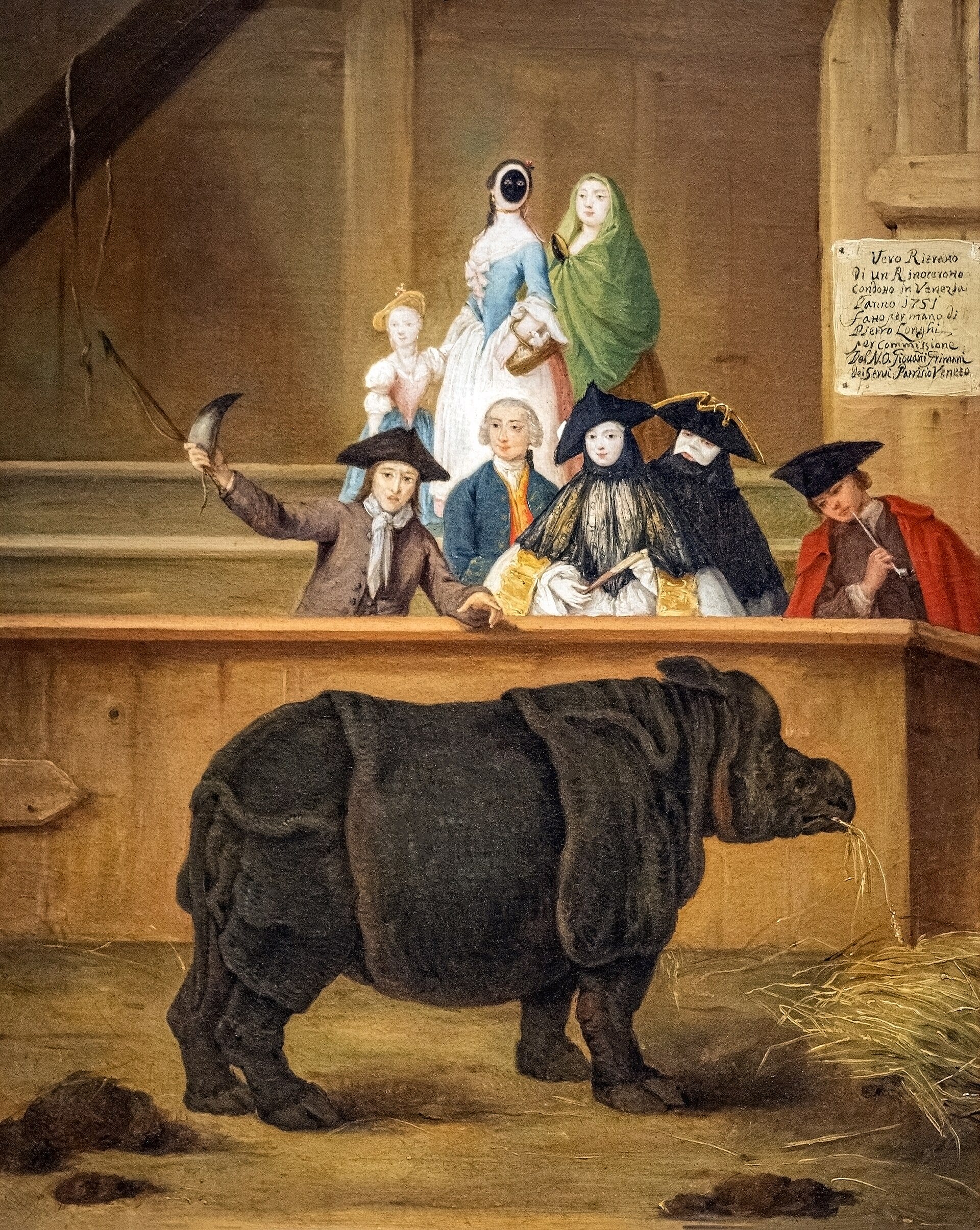
An inscription works as both caption and certificate:
Vero Ritratto di un Rinocerotto condotto in Venezia l’anno 1751 fatto per mano di Pietro Longhi, per commissione Del N.O. Giouani Grimani dei Servi Patrisio Veneto
True Portrait of a Rhinoceros brought to Venice in the year 1751 made by the hand of Pietro Longhi, commissioned by the Nobleman Giovanni Grimani of the Servi, Venetian Patrician.
Grimani, the patrician who paid for it, wanted the painting to say one thing: this rhinoceros was real. It had stood there, in that room, in 1751.
The animal had a name, and by 1751 it was already famous: Clara.
Clara was born in Bengal, around 1738. Hunters killed her mother; she survived. A director of the Dutch East India Company, Jan Albert Sichterman, took her in and let her wander his estate like a pet. They say she was tame.
In 1740 a ship’s captain, Douwe Mout van der Meer, bought her. He loaded her aboard and brought her to Europe. She landed at Rotterdam on 22 July 1741, and was on show within days.
The crowds were good enough that in 1744 van der Meer quit the Dutch East India Company to do nothing else. For seventeen years, from Rotterdam to London, Clara moved from city to city: Vienna, Berlin, Dresden, Leipzig, Paris, and down to Venice. People paid to see her.
In Paris, she became a fashion. People wore their hair à la rhinocéros. Jean-Baptiste Oudry painted her life-size in 1749, a canvas as tall as the animal. At Meissen, Johann Joachim Kaendler made porcelain figures of her.
They're said to have rubbed fish oil into her skin to keep it supple, and they moved her in a wooden wagon built to her size. She'd lost her horn in Rome: sawn off for safety, or worn down in close captivity.
Until then, in Europe, the rhinoceros had been mostly an image.
In 1515 Albrecht Dürer engraved one he’d never seen, plated like a knight in armor. That print became the rhinoceros for more than two centuries, copied into books as if drawn from life.
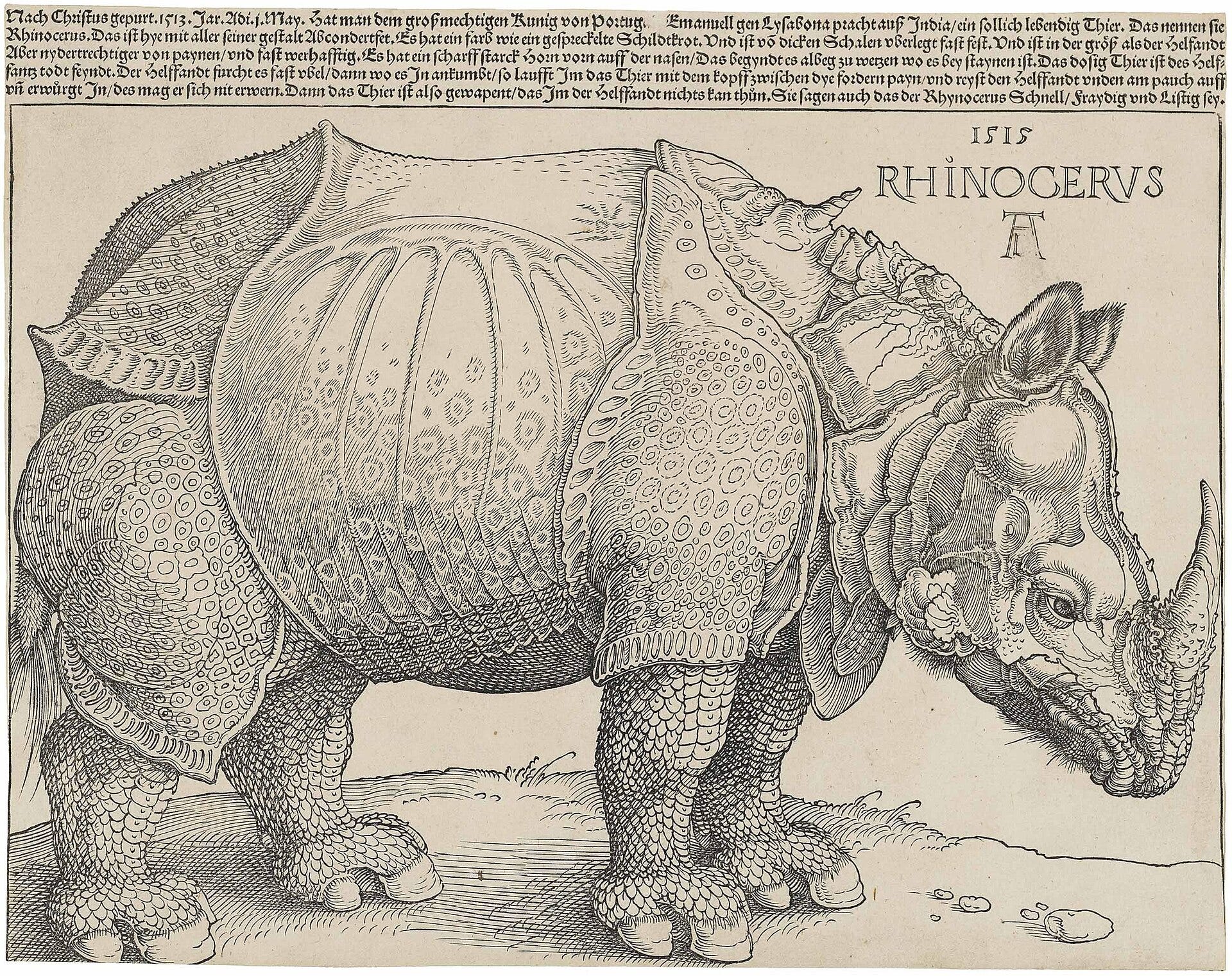
Clara was the thing in the flesh, something you could walk around and draw while you watched. That’s why Grimani had them write: true.
Clara reached Venice for the carnival of 1751.
In a city of masks and merchants, a fabulous creature from India in the middle of the room drew a crowd. Longhi painted her, and even more he painted the people watching: the faces behind the masks, the poses. The rhinoceros is calm. It’s the Venetians who put on the show.
From a river in Bengal to the stages of half of Europe: for seventeen years Clara toured the continent like a seasoned diva, the custom wagon, the portraitists waiting for her in every town.
She died in London on 14 April 1758, still on the road. She was about twenty.


very interesting, my next article is also about exotic imports.... not just animals. the Durer engraving is already on my draft... I will put a link to your article,
Clara seems unfazed by the human show, she wisely keeps on having her breakfast.