

Snow shoveler with frozen hands
Avon Fortunato, a tinsmith aged 63, living at San Polo 952, being unemployed, offered his services to the wardens overseeing the men shoveling the snow that had fallen days earlier.On the 14th of this month, as he began this work, he developed symptoms of freezing in his hands and yesterday, in the doctor’s judgment, he had to go to the Hospital, where he was admitted and where he was declared likely to recover in 25 days, barring complications.
(Gazzetta di Venezia, Thursday 21 February 1929)
Mr. Avon Fortunato, a tinsmith by trade but unemployed at the time, was among the volunteers who at the beginning of 1929 made themselves available to the authorities to shovel snow in Venice.
In the early months of 1929 a major cold wave hit Europe, and Venice was not spared.
How does a city of water like Venice function when the water, its main means of communication, is frozen?
Snowfall (January 1929)
Local reports told of a heavy snowfall at the end of January, one unlike any seen for a long time in Venice.
Venetians reacted with a mix of surprise and amusement: some brought out skis for a short run in St Mark’s Square, and children played snowball fights in the calli.
At the same time, the disruptions caused by the snow were not overlooked: cleaning and clearing the narrow Venetian streets and the 310 bridges that connected the city internally required a considerable amount of extra staff, volunteers such as Mr. Avon Fortunato, employed by the Municipality or by the company holding the contract for bridge maintenance.
There were numerous reports of falls due to ice, and even of injuries caused by snowballs rashly thrown by mischievous boys in the streets.
A drop in temperatures was expected for February, and it arrived on schedule.
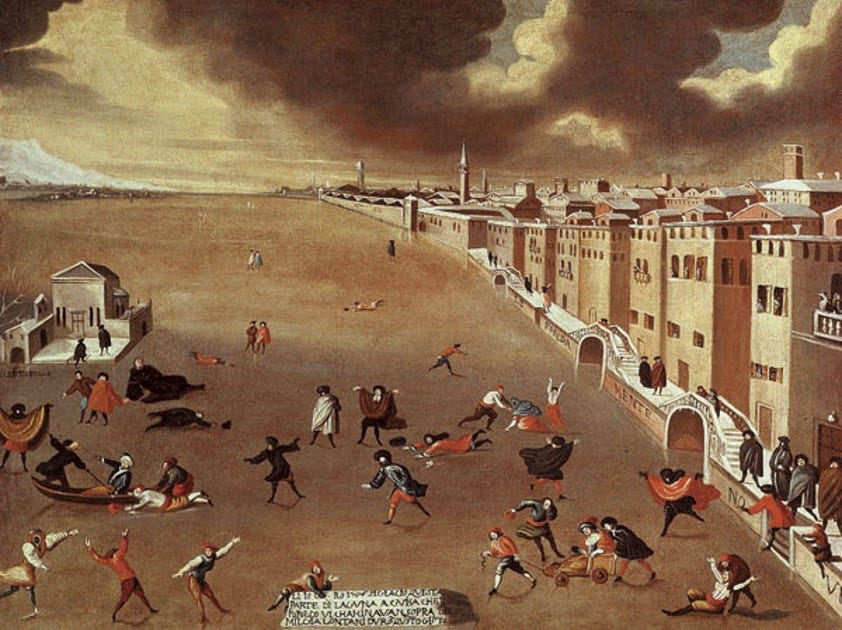
Venice frozen lagoon in 1709, by Gabriele Bella (attr.)
Freeze (February 1929)
At the beginning of February, the so-called “Presages Office” of the Magistrato delle Acque recorded polar temperatures that led to the freezing of the lagoon.
Navigation grew increasingly difficult and, day after day, the city was gradually cut off. Moreover, links between one island and another were also blocked, and some resident families had to be assisted by military means.
Supplies from the mainland began to fail: first milk, then vegetables, eggs, fish and meat. In the mornings, water pipes were frozen, causing problems even for sanitary facilities.
Trains were delayed or failed to arrive altogether. Even the luxury train, the Orient Simplon Express, built up serious delays:
Yesterday at 3.14 p.m. the Orient Simplon Express arrived in Venice… from the day before. Due to violent snowstorms encountered in Yugoslavia, it had built up an exceptionally large delay of twenty-seven and a half hours; it was in fact scheduled to arrive at 11.42 on Monday morning.
(Gazzetta di Venezia, Tuesday 5 February 1929)
The freeze severely affected the much-anticipated Venetian Carnival: “this year, whether or not due to atmospheric elements allied against all outdoor amusement and all square festivities, Carnival did not exist” (Gazzetta di Venezia, Monday 11 February 1929).
And further:
It seemed that the harsh breath of an imported bora wind, since Venice does not recall an equally violent one blowing from the first quadrant, penetrated even into buildings.
As a result, the vigils and festivities organized indoors were affected by the general icy conditions and could not provide the press with enough material to note the traditional crowds of the past.
(Gazzetta di Venezia, Monday 11 February 1929)
To the rhythm marked by the bulletins of the Presages Office, frequent falls of men were recorded and, on the mainland, also of horses, especially in the area of the Mestre railway station.
Shelters for the poor overflowed with homeless and indigents who could not afford heated housing. Some unfortunate individuals died frozen.
Since the ice prevented the use of funeral boats, the authorities converted two vaporetti to transport coffins to the cemetery.
Icebreaker
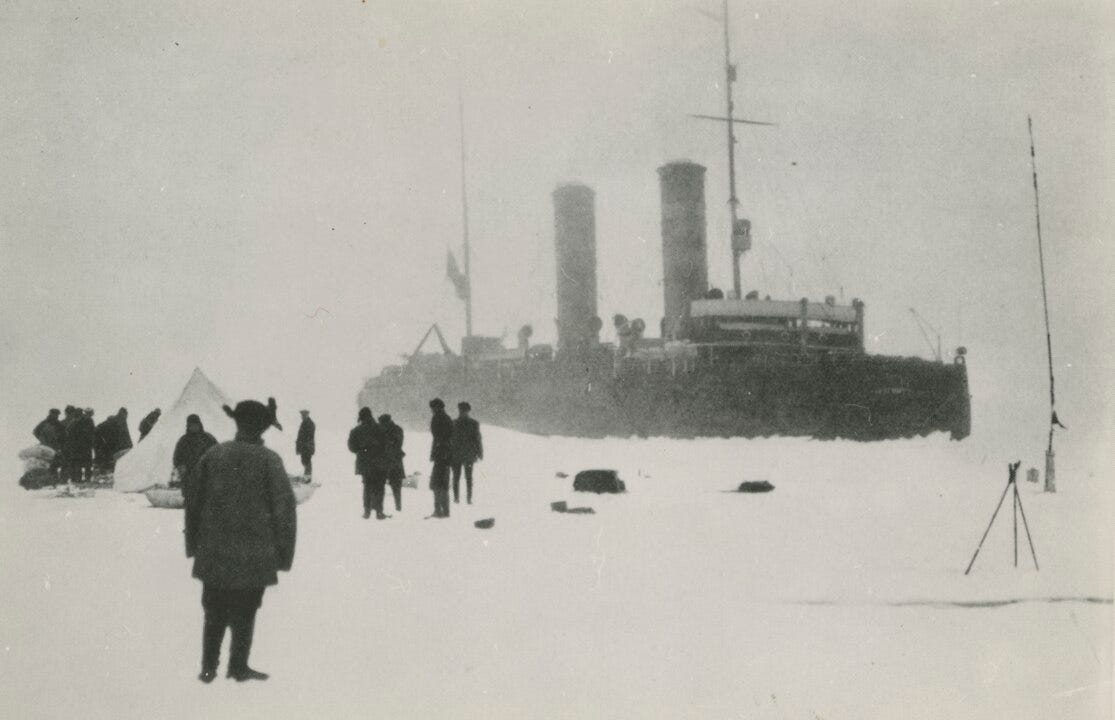
By an irony of fate, on those very days a film entitled “Krassin” was being shown in preview at the Teatro Malibran.
Krassin was the name of a Soviet icebreaker ship that the year before had played a key role in the rescue of the airship Italia, wrecked on the Arctic pack ice.
The airship Italia was part of a scientific expedition to the North Pole led by Umberto Nobile and financed by the Italian state. During the return journey, on 25 May 1928, it crashed onto the Arctic ice because of a storm.
The survivors set up camp on the pack in a tent coloured with red paint recovered on board, the “red tent”, which became the reference point for the searches.
The rescue operations lasted forty-nine days, caused the death of nine men and also cost the life of the famous explorer Roald Amundsen, who disappeared while taking part in the searches with his seaplane.
The Gazzetta reports that some boats used in those cold days to ply the frozen lagoon were nicknamed “Krassin”: this was the case of boat number 5, which ensured the connection with the island of Sacca Sessola, home of a sanatorium for the treatment of tuberculosis.
Winter games
The spectacle attracted hordes of amateur photographers “armed with Kodaks”, who walked across the frozen lagoon and portrayed this unusual sight.
There were those who explored the lagoon on skates, on skis or on snowshoes.
It is reported that at midday, to faithfully recreate the scene, a group of cheerful revellers (heaven forbid there should be none in this world!) carried a table, chairs, food and a stove onto the ice, and set themselves a small lunch laid out according to all the rules.
(Gazzetta di Venezia, Sunday 17 February 1929)
Toward the end of February the freeze began to ease and the lagoon, slowly, freed itself.
Boats resumed crossing the canals and life began to flow again in the calli.
A few months later, the Gazzetta announced on its front page: “The new Statute of the Fascist Party – ‘The Party is a civil militia at the service of the Nation’”.
On the last page, on that same day, a small article also appeared: “Cyclone on the New York Stock Exchange – Billions of dollars lost to speculation”.
It was 30 October 1929.


Very cool read!
Favoloso! Bravo!!!