

In a 14th-century Venetian chronicle, under the year 1177, two umbrellas stand open, one over the pope, one over the emperor.
Andrea Dandolo, a doge and chronicler, is writing about the Peace of Venice: the year Alexander III and Frederick Barbarossa made their peace, after Legnano. The men of Ancona present two of them, he says, unam Papæ, Imperatori aliam.
They’re a mark of honor.
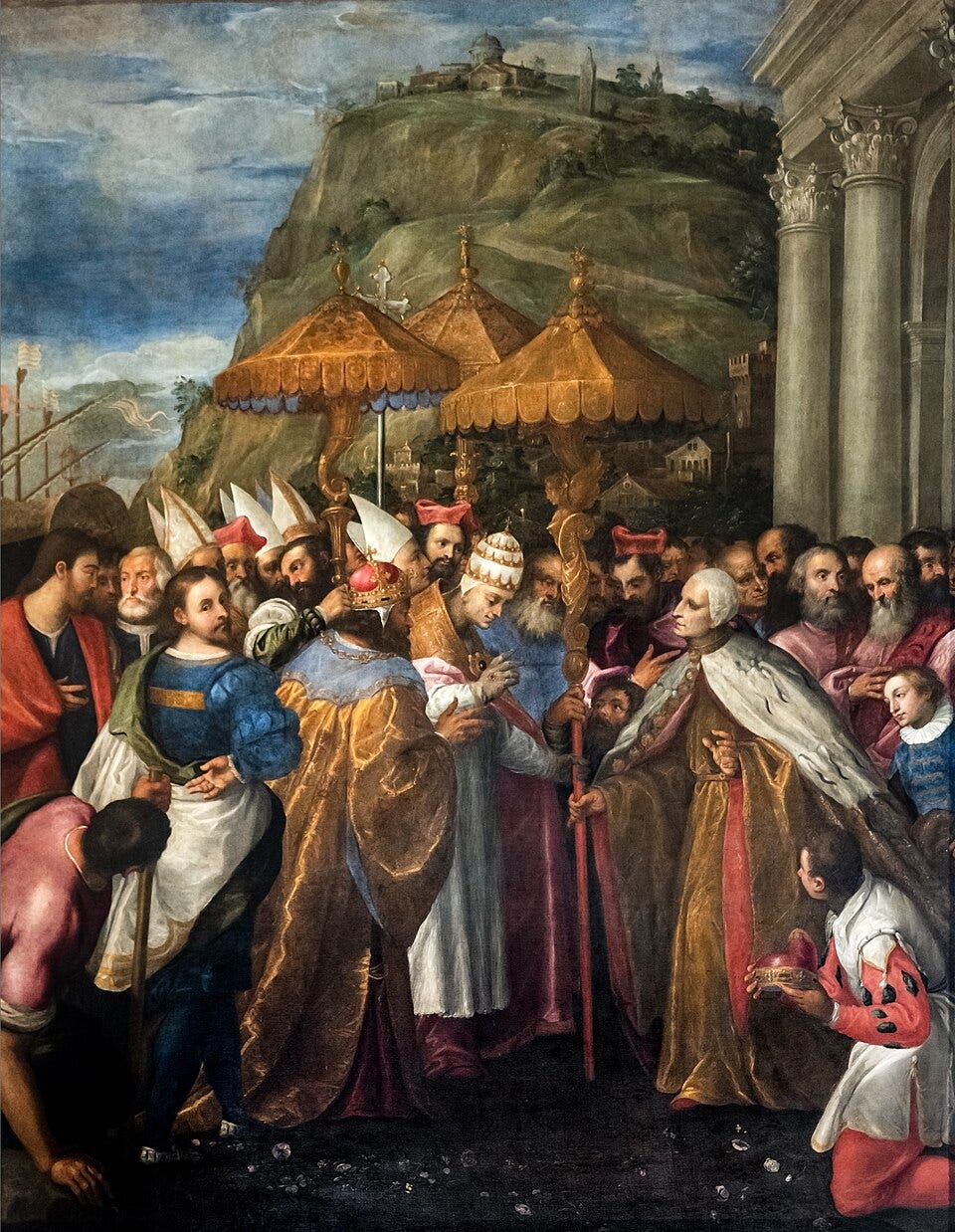
Gerolamo Gambarato, The Pope arrives on Venetian ships in Ancona (1582)
The word is already there: umbrella. It comes from ombrella, from ombra, from the Latin umbra. It says what the thing does, or did: shade. In hot countries shade is a privilege, and someone holds it over you while you walk.
Four centuries on, it’s still a sun thing.
In a 1595 album, the keepsake book of a German soldier passing through Italy, a rider on a white horse holds up a ribbed parasol, fringed with gold. Beside him, the caption: “A questo modo se cavalchano l’istate in Itallia.” This is how they ride in summer in Italy.
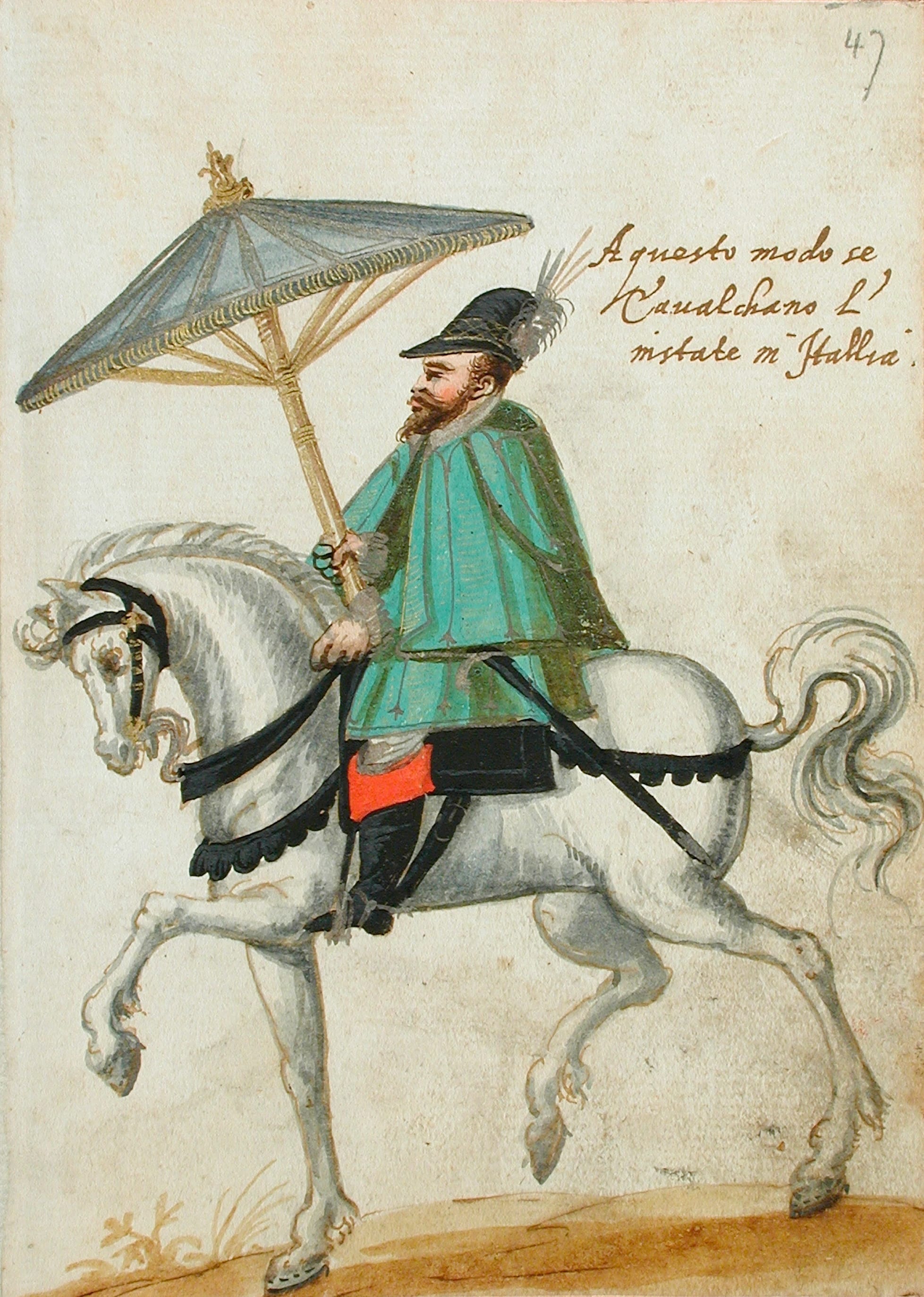
Sixteen years later an English traveler, Thomas Coryat, writes it down too. Between Pizzighettone and Cremona he sees Italian horsemen carrying it by hand, the handle braced against one thigh, a canopy of leather:
things that minister shadow unto them for shelter against the scorching heate of the Sunne.
Against the sun. He calls it by the Italian word: umbrella.
Then the word travels north, to England, and there the little shade changes its meaning. Against the rain.
At first it’s a women’s thing, a lady’s accessory. The first men to open one in the street get laughed at.
Around the middle of the 18th century Jonas Hanway walks through London in the wet with his umbrella up, and people jeer at him. They take him for a foreigner, a fop. Probably for a cheapskate too, since he’d rather keep himself dry than pay for a carriage like everyone else.
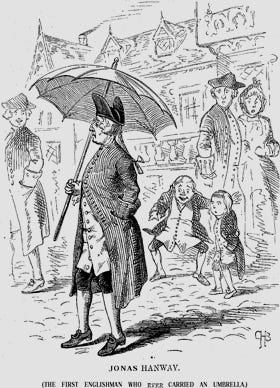
From the end of the century the habit spreads fast, at least in the cities.
The word, though, stays unchanged. You still carry a “little shade” even when you open it to keep dry.
The French were more honest. They had the same fossil word, ombrelle, taken from Italian. But for the thing that keeps off the rain they found a new, plain name: parapluie, “against the rain,” built on the model of parasol, “against the sun.”
The word first shows up in 1622. Over time the shade stayed with the sun, and the rain got its own name.
The thing you open tonight against the rain is still called a shade. Once they held it over a pope. Now you leave it on the train.
Read also


Bibliography
Andrea Dandolo, Chronica (XIV sec.), sotto l’anno 1177, cit. in Du Cange, Glossarium mediae et infimae latinitatis, s.v. “umbrella”.
Thomas Coryat, Coryat’s Crudities (Londra, 1611).
John Florio, A Worlde of Wordes (Londra, 1598), s.v. “ombrella”.
Oxford English Dictionary, s.v. “umbrella”.
Trésor de la langue française informatisé (CNRTL), s.vv. “parapluie”, “parasol”, “ombrelle”.
Les Œuvres de Tabarin (1622).
Antoine Furetière, Dictionnaire universel (1690), s.v. “parapluye”.
Chronique bordeloise (1580).
Thanks for this. Amusing that the first man in Britain to use one - in London - was laughed at. I was born in the north of England and you were regarded as a bit of a ;sissy' if you used on. I still never use one, not because of that, but I just don't like carrying one around. If its bad weather I prefer to wear a hat or a jacket with a hood. The one period I did use one quite regularly was when I was in the Royal Marines and served in Singapore and Malaysia. The bamboo umbrellas came in useful in monsoon season! :-)
Also in Tarquinia's beautiful Etruscan museum..the .ribs are made of bone...