

Some time ago I published a note about a painting, now held at the Uffizi Gallery in Florence, showing a young girl, the daughter of Cosimo I de’ Medici.
This is what I wrote:
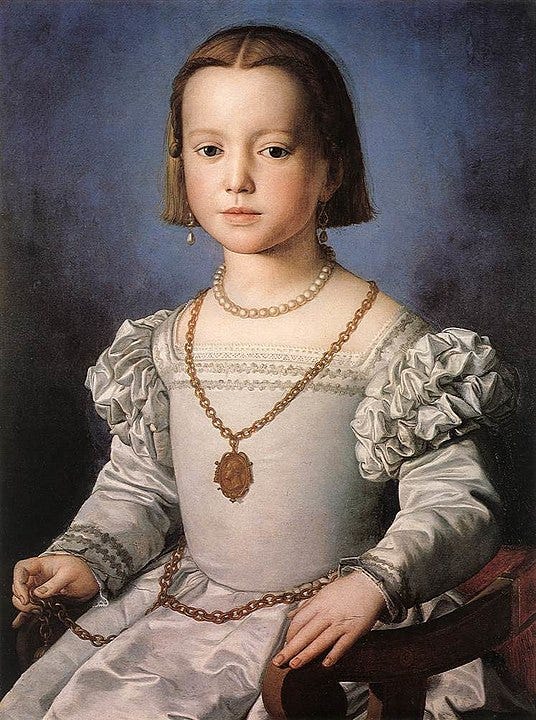
Her pose follows the formal conventions of court portraiture, but Bronzino reveals who this child truly was through careful details. He likely painted her between 1542 and 1545, some time after Bianca de’ Medici (called Bia) had already died.
Cosimo I’s illegitimate daughter lived at the Florentine ducal court, surrounded by affection: her father loved her, as did her stepmother, Eleonora di Toledo, and the rest of the family. Then, sudden illness claimed her in 1542. She was only five.
Bronzino dresses her in white, a nod to her name (Bianca means “white”) and innocence. She wears pearls and a medallion with her father’s portrait, adorned like a grown woman. Yet her hands tell a different story. They fidget with the belt’s tassel, press the chair’s arm with restless energy: these are the hands of a child who would rather be playing than sitting still.
Bronzino captures her as she was: not the woman she might have become, but an impatient little girl dressed like a princess, frozen forever in her finery.
Today, visitors can meet Bia at the Uffizi Gallery in Florence.
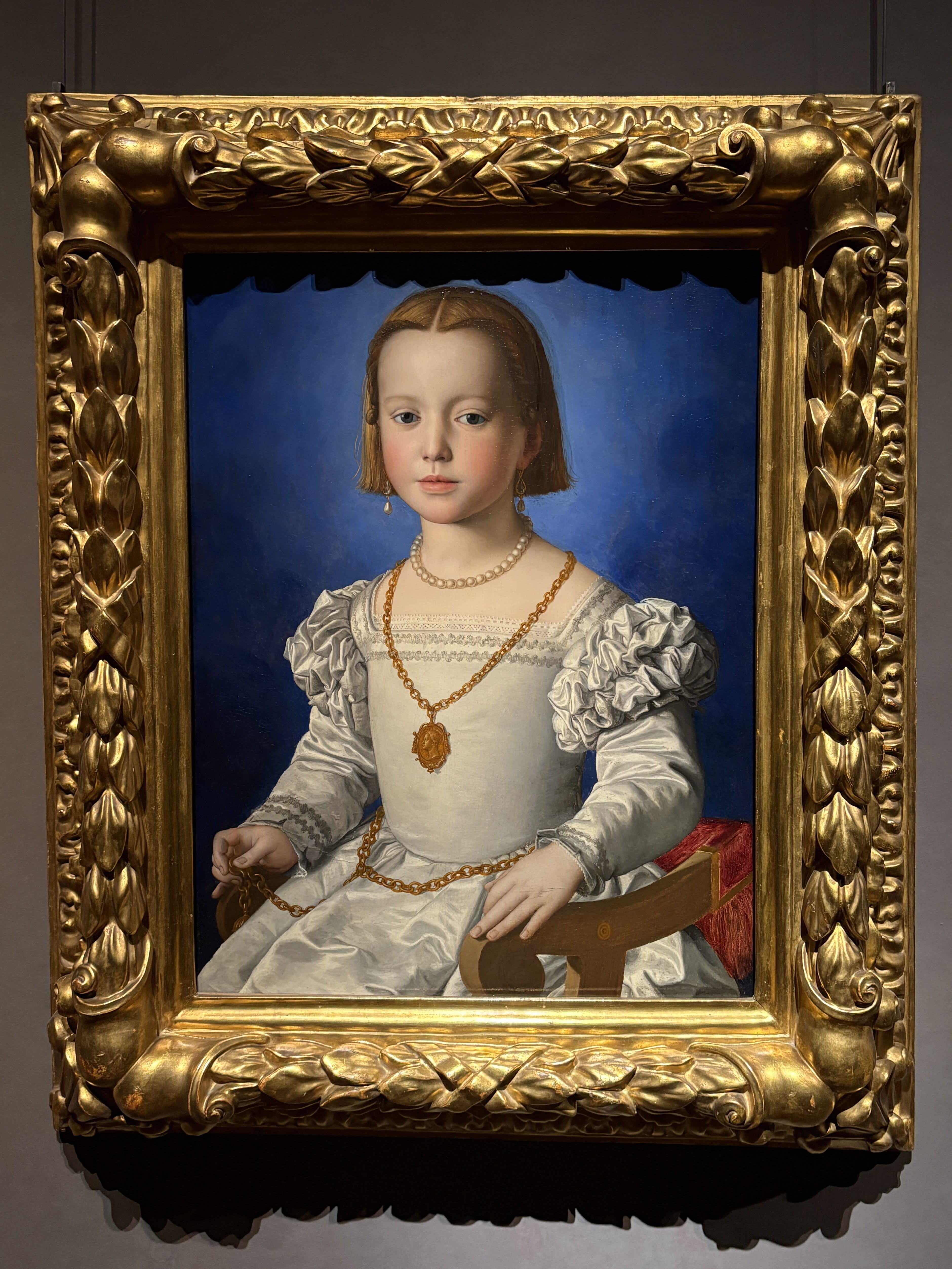
Recently I met Bia in Florence.
I had not been looking for her as I walked through the endless corridors of the Uffizi; she appeared before me all of a sudden. The colours were more vivid, and the lines clearer, than in the thousands of images of her circulating online.
In that moment, Bia was truly there with me.
I could only think back to her story, to her short life – short like that of many other children of her time who died young.
People say that in the past, when death was everywhere, it was met with greater fatalism and resignation than in our present age of denial. I cannot say.
As I stood there looking at Bia, another portrait suddenly came to mind, seen elsewhere and from another period of Italian history.
In Rome stands one of the most renowned monumental cemeteries established in nineteenth-century Italy, the Verano. Many notable figures and members of prominent families of the Capital are buried in this large resting place.
The Verano contains more than 250 portraits made by Filippo Severati, whose distinctive technique (enamel on lava) has preserved the faces of the people buried there. These images are vivid and show, in their details (hairstyles, jewellery…), the period in which they were made.
Among Severati’s portraits is that of Marietta Fiori who, as her headstone records, died on 22 February 1873, “aged 4 months 6 days 12”. Her parents were Giovanni and Antonia.
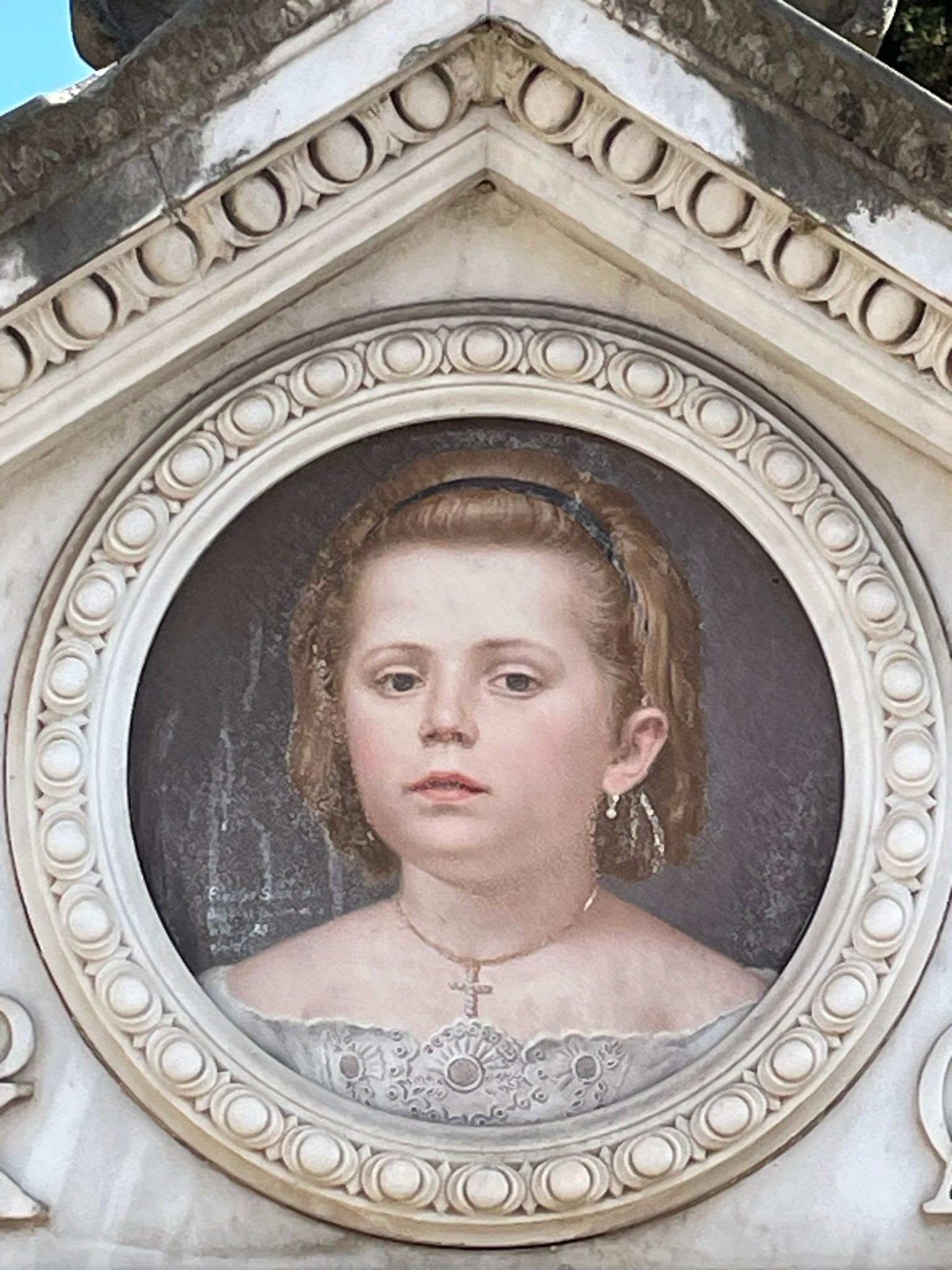
More than 330 years separate Bia from Marietta, yet these two girls, both around five years old, shared the same fate.
We do not know exactly what caused Bia’s death: perhaps a malarial fever. Other frequent causes of childhood death at the time, beyond cyclical plague epidemics, were gastrointestinal disorders and smallpox.
By contrast, we do know that Marietta died of diphtheria. I have noticed that at Verano hers is not the only child’s grave whose headstone lists this cause of death in those years. Indeed, looking through the Reports on civil-status activity for the years 1872 and 1873, I found that two epidemics were recorded in 1872 in Rome (smallpox and diphtheria), which caused very high child mortality that year and continued well into 1873.
Diphtheria, an infectious disease affecting the throat and the respiratory tract, was then one of the leading causes of childhood mortality. Only a few years later, in 1894, the arrival of the antidiphtheritic serum began to reduce mortality significantly.
I had not expected to encounter them on the same day, Bia in Florence and Marietta in my memory.
And now, when I think of one, I inevitably think of the other: two blonde girls, dressed in white, wearing jewellery meant for adults yet keeping, in their painted features, the freshness of an untouched childhood.


Very good. On so many levels, a portrait helps those who are gone to be among the living, regardless of one's beliefs about the afterlife.
So, going to the trouble of seeing the painting in person, connecting with the eyes, linked to the person's mind/soul, is indeed helping Bia be present at the very moment you are looking at her.
Even better, writing a story about that and sharing it here is helping revive, if only for an instant, Bia and Marietta. Well done.
I'm glad you published this story. You told it movingly and beautifully, a fitting tribute to the children who leave this world too soon.