

On a rock ledge at 3,210 metres, inside a crack, resting on a piece of hide, lay an axe. Its blade was copper, its haft was made of yew and measured about sixty centimetres.
Four metres away, lying face down across a boulder, was the man it belonged to.
Nobody took the axe. Not the bow, not the quiver or the dagger. It all stayed there, for millennia.
And the copper in that blade wasn’t even Alpine. It came from the copper deposits of southern Tuscany, hundreds of kilometres to the south. Metal that had crossed half the peninsula, left on a Tyrolean glacier beside a dead man.
The man carried an unfinished bow and, out of fourteen arrows, only two ready to shoot. He’d been born and spent his entire life within about sixty kilometres of that spot, always south of the watershed.
He was about forty-six, and he’d died around 3300 BC, deep in the Copper Age.
Today we call him Ötzi, and he’s probably the most studied body in archaeology.
We’ve read his genome, counted his tattoos, reconstructed his last meal, sequenced the bacteria in his gut. On one thing, though, we still don’t agree: how did he die?
From accident to murder
For ten years the answer was simple.
He’d lain down in a hollow, worn out, and frozen to death. An accident: a man alone, caught by bad weather too high up.
Then, in 2001, an X-ray showed an arrowhead in Ötzi’s left shoulder. It had gone in from behind. The entry wound, clean-edged, measured two centimetres.
In one day, the frozen hiker became the victim of a murder.
But this wasn't his only wound. A deep cut ran across his right hand, between thumb and forefinger, inflicted a few days before he died. Possibly a defensive wound, the mark of a fight at close quarters. His death had a backstory.
The case seemed to have been solved quickly. The arrow had torn the subclavian artery, and he’d bled out in minutes. Then someone added a head injury to the picture: a fall, or a last blow to the skull.
It didn’t close.
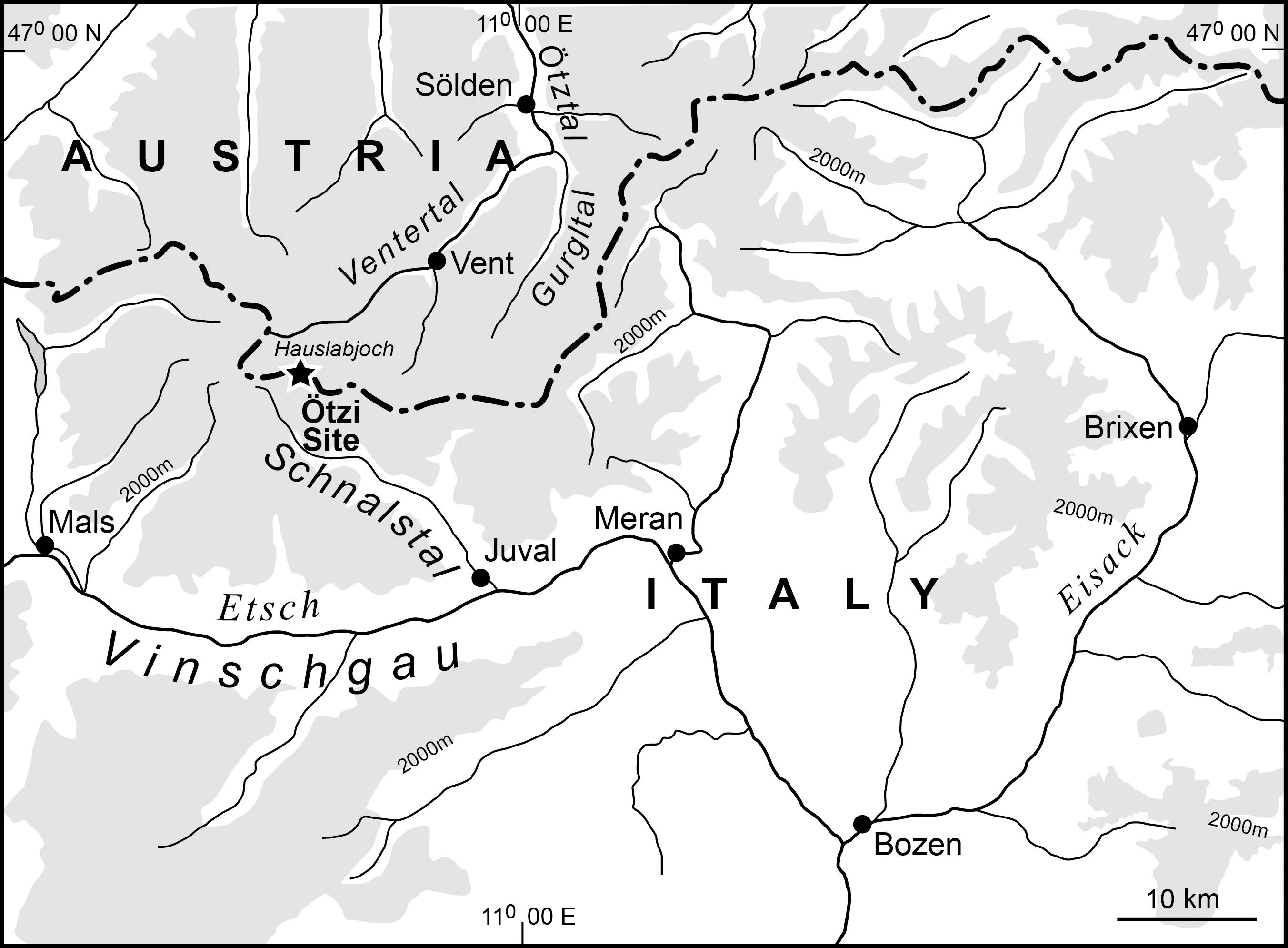
The find site, on the watershed between the Ötztal (Austria) and the Schnals valley (South Tyrol, Italy). Map: Dickson JH, Oeggl KD, Kofler W, Hofbauer WK, Porley R, Rothero GP, et al., "Seventy-five mosses and liverworts found frozen with the late Neolithic Tyrolean Iceman", PLOS ONE 14(10): e0223752 (2019), Fig. 1. Licensed under CC BY 4.0.
The same finds, different deaths
Look closer, and even the scene splits in two. Some, studying how the objects lay scattered around the body, decided Ötzi had died right there, and that the ice had dragged his gear about over the millennia. Others, from the same objects, read a burial: he’d died down in the valley in spring, been carried up high and laid to rest with his things.
The same handful of finds, two different deaths.
His last hours divided researchers too.
From the pollen left in his gut, someone traced a route: in his final thirty-three hours Ötzi had gone down to the warm broadleaf woods, at twelve hundred metres, and then climbed back above three thousand.
Some interpreted that rapid descent and ascent as evidence of flight.
But his stomach said otherwise. For years they’d thought it empty; then it turned out to be full. A few hours before he died, Ötzi had eaten well: ibex and red deer, einkorn, cooked over a fire. A man on the run doesn’t stop to eat like that.
Maybe he’d stopped to rest, and the arrow caught him off guard, from behind?
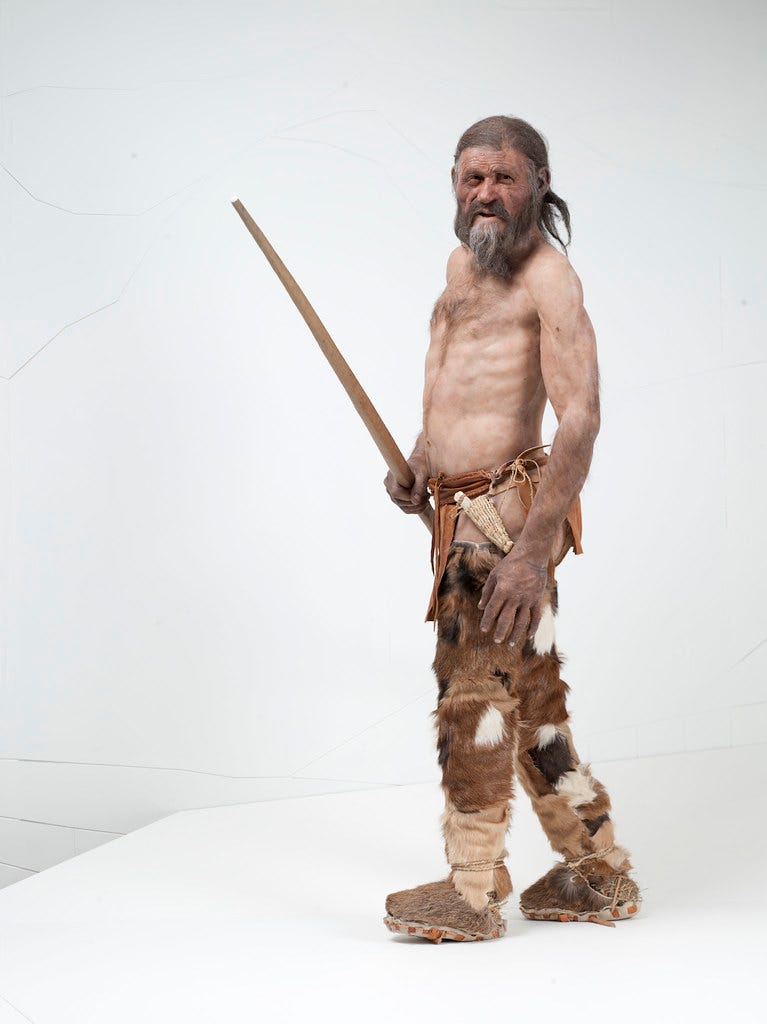
A reconstruction of the Iceman in the South Tyrol Museum of Archaeology in Bolzano, Italy (Source: South Tyrol Museum of Archaeology)
The case reopens
In 2022, just over thirty years after the discovery, a reappraisal shifted everything again. Researchers who study how ice preserves and moves whatever lies on its surface concluded that the Tisenjoch scene is no snapshot of a death.
The body and the gear had slid into a gully over centuries of melt. The ice may have arranged what we see today, over five thousand years. Even the blow to the head might be damage that came later.
The supposed “time capsule” had never existed.
The latest reconstructions, from 2025, reassessed the arrow wound itself.
The bleeding, they say, was mostly internal, too little to kill him outright. Ötzi may have survived for hours. One of the two teams adds that there’s no proof of a head blow at all, and that the cracks in the skull can be explained by the ice.
They also point out that his right hand, the wounded one, seems to have been bandaged when he died. Maybe it’s no accident that among the mosses found with Ötzi there’s Sphagnum, which was used to dress wounds.
So, in 1991, in the days after the Similaun mummy turned up by chance, we knew how Ötzi had died. Today we know less.
Every answer has called the one before it into question.
The axe remains
The axe remains, a precious thing back then, and with it the old question: why didn’t the killer take it?
If Ötzi survived for hours and dragged himself higher, the archer may never have reached the body, and there was no axe to take because nobody got that far.
If he was buried, the axe was a gift. If he was ambushed while fleeing, it was left in haste. Three stories, and no way to choose between them.
Someone has pointed out a simple thing. The likeliest reconstruction involves one thaw after another, a confused sequence that is hard to tell as a story. The old reconstruction, the flight and the sudden freeze, makes a good story. And maybe that’s why it’s still told.
The axe remains.
Tuscan copper, on a piece of hide, in a crack in the rock, where someone left it five thousand years ago.
Read also

Further reading
Ötzi is housed at the South Tyrol Museum of Archaeology in Bolzano, and its website is the place to follow him: iceman.it. It’s a rich, well-kept resource: the body and its equipment, the full research history, and the latest discoveries as they’re published.
Bibliography
W. Müller et al., Origin and Migration of the Alpine Iceman, Science 302 (2003).
E. Egarter Vigl, P. Gostner, Insight: Report of Radiological-Forensic Findings on the Iceman, Journal of Archaeological Science 29 (2002).
A. Nerlich, B. Bachmeier, A. Zink, S. Thalhammer, E. Egarter Vigl, Ötzi had a wound on his right hand, The Lancet 362 (2003).
P. Pernter, P. Gostner, E. Egarter Vigl, F. Rühli, Radiologic proof for the Iceman’s cause of death (ca. 5300 BP), Journal of Archaeological Science 34 (2007).
K. Oeggl et al., The reconstruction of the last itinerary of “Ötzi”…, Quaternary Science Reviews 26 (2007).
A. Heiss, K. Oeggl, The plant macro-remains from the Iceman site (Tisenjoch), Vegetation History and Archaeobotany (2009).
A. Vanzetti, M. Vidale, M. Gallinaro, D. Frayer, L. Bondioli, The iceman as a burial, Antiquity 84 (2010).
P. Gostner, P. Pernter, G. Bonatti, A. Graefen, A. Zink, New radiological insights into the life and death of the Tyrolean Iceman, Journal of Archaeological Science 38 (2011).
G. Artioli et al., Long-distance connections in the Copper Age: New evidence from the Alpine Iceman’s copper axe, PLOS ONE 12(7) (2017).
L. Pilø, T. Reitmaier, A. Nesje, A. Fischer, J. Barrett, Ötzi, 30 years on: A reappraisal of the depositional and post-depositional history of the find, The Holocene 33 (2022).
J. Weber, J. Wahl, M. Samadelli, A. Zink, New insights on Ötzi’s injuries from a clinical perspective, Scientific Reports (2025).
C. Villa, N. Lynnerup et al., Ötzi the Iceman: forensic 3D reconstructions of a 5300-year-ago murder case, International Journal of Legal Medicine (2025).
A very interesting account. We know far less about his death than I had thought. Thanks for the update!
It seems that, the more tools we can use, the fewer clues we hold in the end. Fascinating and compelling read!