

Some days ago, I came across a rather obsolete Italian word: maramaldo.
A quick look in the dictionary told me it means something like “someone taking advantage of the weak”. A theme that, unfortunately, seems to be quite fashionable these days.
Apart from the fact that the sound of the word is so pleasing that I would gladly start a petition to bring it back into use, its origin is just as curious and compelling.
The term comes from a certain Fabrizio Maramaldo, a Neapolitan mercenary captain active in sixteenth-century Italy.
His military career is said to have begun after he was banished from his hometown for killing his first wife. An encouraging start.
He entered the service of powerful employers, among them the Gonzaga family and Emperor Charles V of Habsburg. In the Emperor’s service, he took part in the infamous Sack of Rome in 1527.
In 1530, still under imperial command, he marched against Florence, targeting the Florentine Republic which had expelled the Medici from power. It was in this context that captain Maramaldo made his name, leaving behind the word that would forever carry his infamy.
In August 1530, Maramaldo clashed with Florentine forces led by Francesco Ferrucci at the Battle of Gavinana. It seems the two men entered the confrontation carrying a considerable load of personal resentment.
Questions of wounded honor. During an earlier siege of Volterra, Ferrucci had ordered the killing of one of Maramaldo’s envoys, sent to demand the city’s surrender. For his part, Ferrucci had the man killed after he returned a second time. On the first occasion, he had merely been driven away, with the threat of hanging should he come back.
It is also said that the envoy was not, in fact, an envoy at all, but a simple drummer, and that this lack of respect enraged Ferrucci.
Be that as it may, Maramaldo’s troops prevailed at Gavinana. When the fighting was over, the wounded Ferrucci was brought before Maramaldo. Maramaldo struck him and then ordered his men to finish him off.
Before dying, Ferrucci is said to have uttered the famous words that sealed his enemy’s reputation: “You vile man, you kill a dead man.”
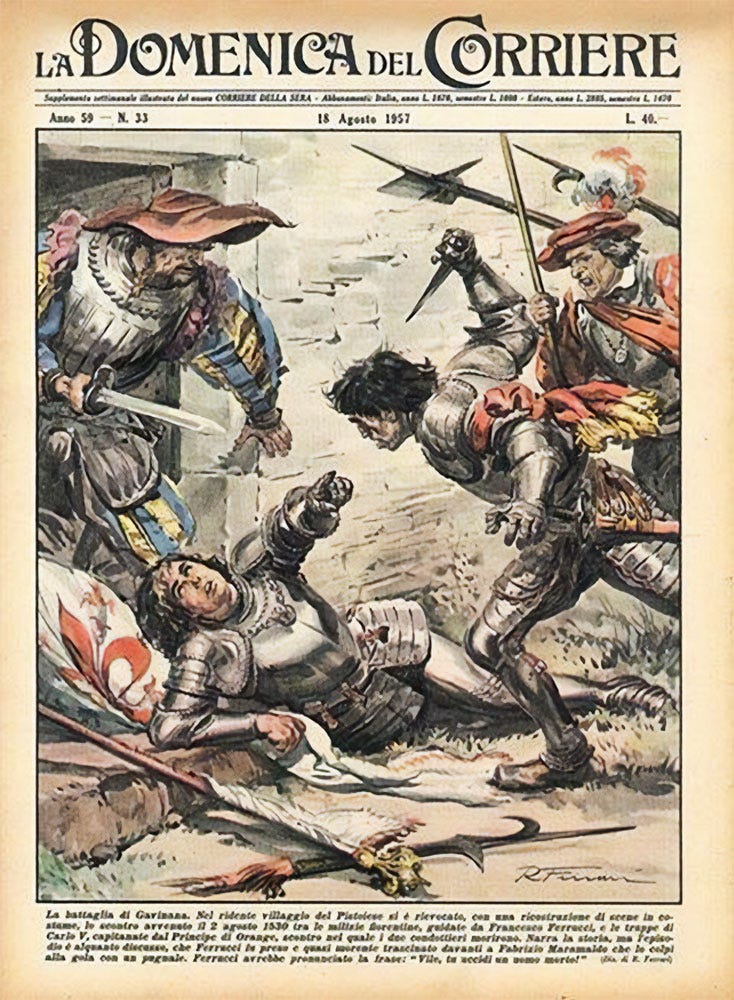
A cover of La Domenica del Corriere recalls the episode in August 1957.
Or perhaps none of this happened at all.
It is unclear whether the episode truly occurred or whether it was later shaped by pro-republican propaganda. What is certain is that the image of the vile Maramaldo, in imperial pay, tormenting Ferrucci, the defender of liberty, was eagerly taken up by Risorgimento-era rhetoric.
In any case, only a few days after the Battle of Gavinana, Florence surrendered to the imperial forces and accepted the return of the Medici.
Maramaldo died in 1552, having retired from what was, by all accounts, a respectable military career.
Historical memory has not been kind to the Neapolitan mercenary captain: today, in Italy, calling someone a maramaldo is a picturesque insult, with a distinctly vintage flavor.
Read also:


It's the kind of expressive names that lend themselves to become nouns.