

History is a field that is constantly revised through new discoveries, methods, and questions. What we believe we know today is only provisional: tomorrow, it can be confirmed, or rewritten.
That is what draws me to history: its ability to renew itself over time.
I try to keep myself updated on recent research connected to Italy’s past as a way of staying close to this process.
This selection brings together a small number of articles and studies that caught my attention over the past weeks. It is not meant as a comprehensive overview, but as a personal, curated snapshot of ongoing research and occasional findings.
Fano and the possible Basilica of Vitruvius
During redevelopment works in the center of Fano, archaeologists uncovered the remains of a Roman basilica that closely match a building described by Vitruvius in De Architectura.
If the identification holds, this would be the first surviving structure that can be physically linked to the author of the most influential architectural treatise of antiquity.
Monumental Roman Basilica Identified as Long-Lost Work by Vitruvius (via Artnet)
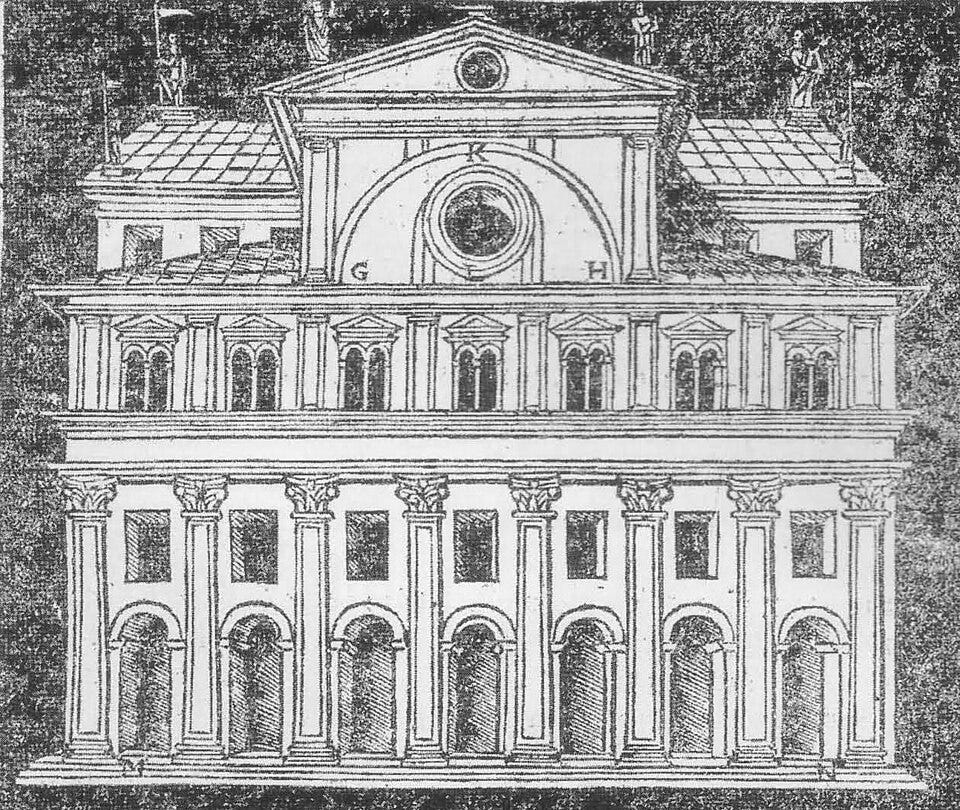
Reconstruction of the Basilica at Fano based on Vitruvius (1521), by Cesare Cesariano.
Archaeological discoveries in Rome
Excavations along Via di Pietralata, on the eastern edge of Rome, have revealed a dense archaeological landscape of roads, tombs, cult spaces, and large basins.
Found far from the city’s most familiar sites, these remains point to forms of ancient activity that took place outside the monumental center and are still preserved beneath today’s suburbs.
Major archaeological discoveries in Rome: a sacellum, republican tombs and monumental basins (via Le Finestre sull’Arte)
Archaeogenetics and Bronze Age Southern Italy
A genetic study of a Middle Bronze Age burial site in southern Italy sheds new light on how small Protoapennine communities were organised, connected, and sustained in marginal landscapes.
Focusing on the remains from Grotta della Monaca, the research raises unexpected questions about kinship, mobility, and social norms in Bronze Age Southern Italy.
Frescoes from a Vesuvian villa
Fresh excavations at the Villa of Poppaea, long buried by Vesuvius beyond Pompeii itself, have brought back fragments of wall painting with an unusual mix of elegance and playfulness.
A mirrored peahen and a comic theatrical mask appear in a room whose layout has puzzled archaeologists for decades. The find opens a narrow window onto a villa still only partly understood.
Archaeologists Discover ‘Sumptuous’ Frescoes at Ancient Villa Preserved by Mount Vesuvius’ Eruption (via Smithsonian Magazine)
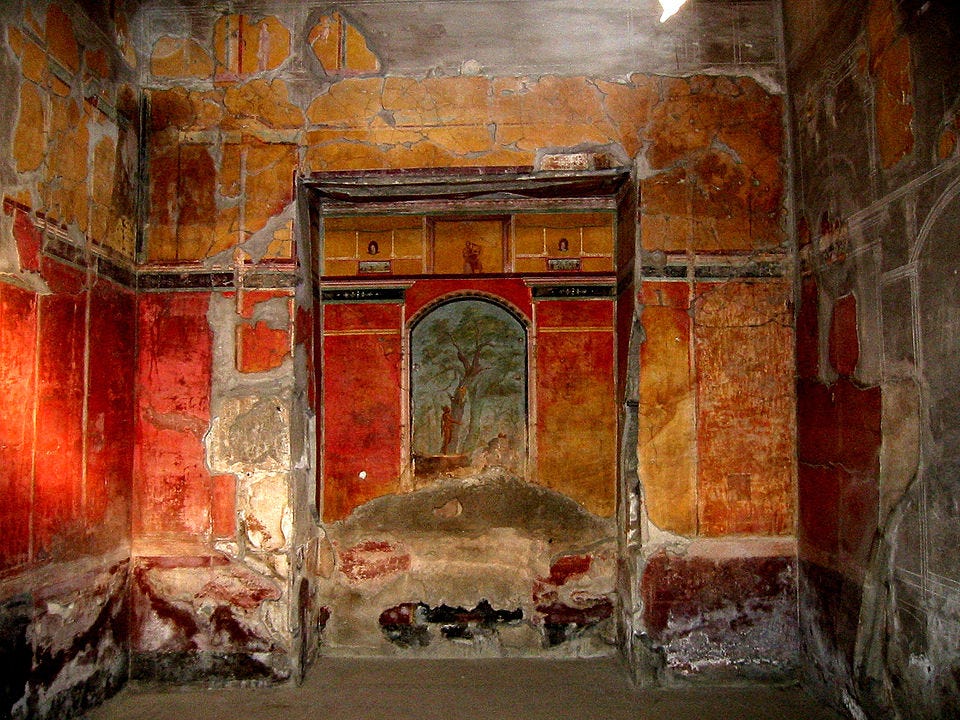
The calidarium of the Villa of Poppaea.
Bathing practices and mineral evidence in Pompeii
Mineral traces sealed beneath Vesuvius’s ash have opened an unexpected window onto how water moved through Pompeii long before Roman rule.
The study links bath infrastructure to Greek and Samnite practices and hints at daily conditions that feel far less idealised than marble ruins suggest.
Lava up: New mineral study reveals buried ‘dirt’ about bath time in ancient Pompeii (via Euronews)
You can't dig a hole in Rome without finding something ancient and wonderful!