

A few days ago news came from Villa Adriana, at Tivoli, of a curious Roman find in the area of the Amphitheater.
It is a marble slab with the inscription FVLGVR SVBMANIVM, still set in the small tufa box it belonged to.
According to the archaeologists it could mark a bidental, that is, a space consecrated after a lightning strike.
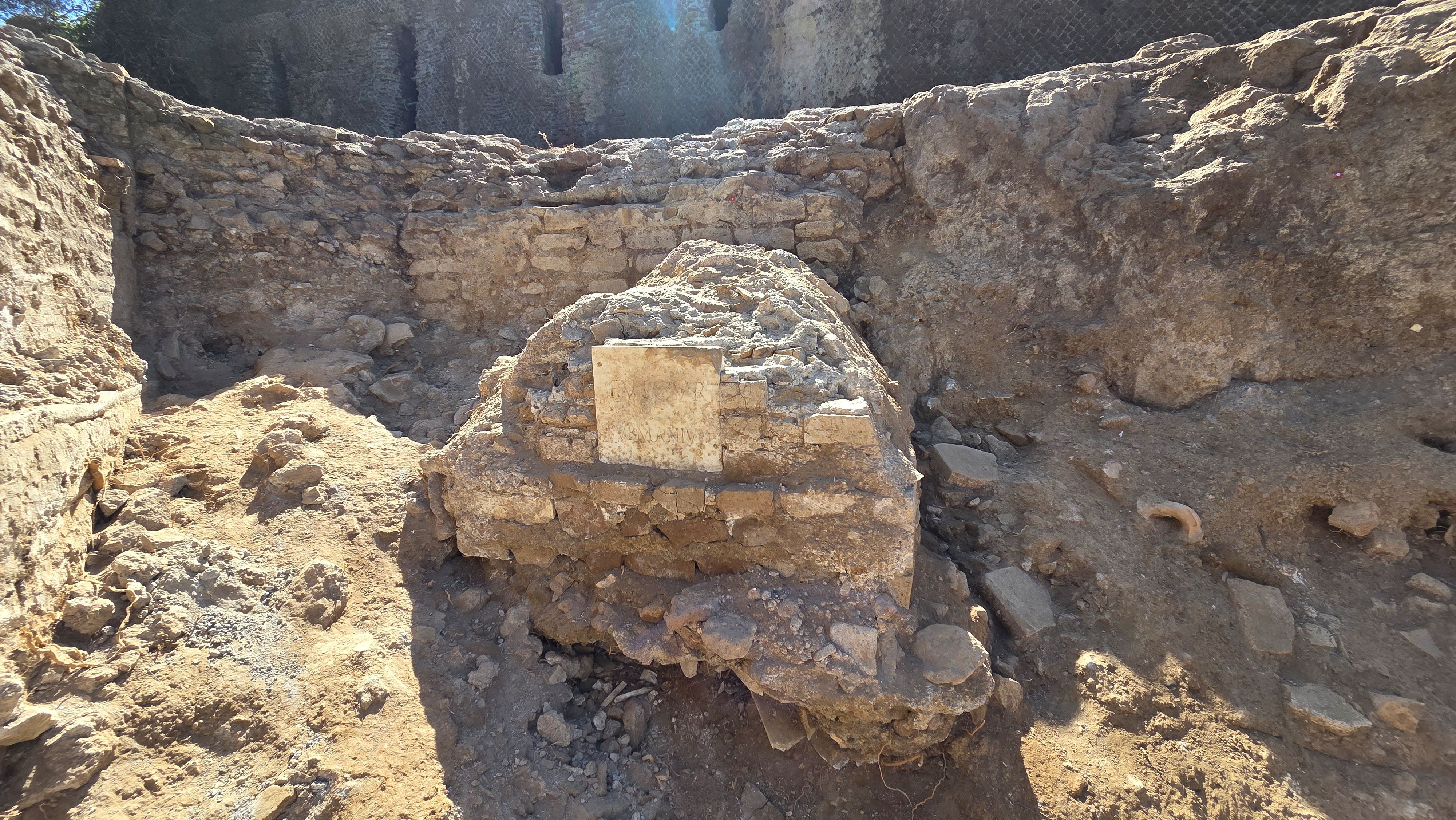
Photo: Ministero della Cultura
Reading lightning
In the Etruscan and Roman world there was a surprisingly complex liturgy around lightning.
Reading lightning was an art, born among the Etruscans and then passed on to the Romans, which made it possible to divine the future and understand the will of the gods by interpreting the region of the sky the lightning came from, its trajectory, and the kind it belonged to.
In his Naturalis Historia, Pliny the Elder says the Etruscans counted as many as nine gods who hurled lightning, and eleven different kinds of it.
The Romans simplified things a little, giving daytime lightning to Jupiter and night lightning to the god Summanus.
The ritual called, among other things, for purifying the place where lightning had struck by “burying” the lightning itself (the expression was fulgur conditum). The material the lightning had touched was collected and laid in the earth, with ritual formulas and a sacrifice.
The strike made that spot religiosus, withdrawn from ordinary use.
The term bidental, the name given to these consecrated areas, is thought to derive from the sacrifice of a two-year-old sheep, a bidens.
The shaft at Todi
What did a place of this kind actually look like?
A good example comes from Todi, where in 2010 another bidental was found, dated to the end of the second century AD.
It is a shaft 90 cm deep holding some 700 fragments of marble with burn marks (probably from a monumental building struck by lightning nearby), pottery, metal, and the bones of cattle and sheep.
Two of the slabs covering the shaft have the words FVLGVR and CONDITVM cut into them.
The Hercules in the pit
There are, at least in Italy, several examples of bidentalia. One of the most spectacular cases involves a work now in the Vatican Museums.
In 1864, under the courtyard of Palazzo Pio Righetti, next to Campo de’ Fiori and inside the area of the ancient Theatre of Pompey, a colossal gilded bronze statue of Hercules came out of a pit, almost 4 meters tall.
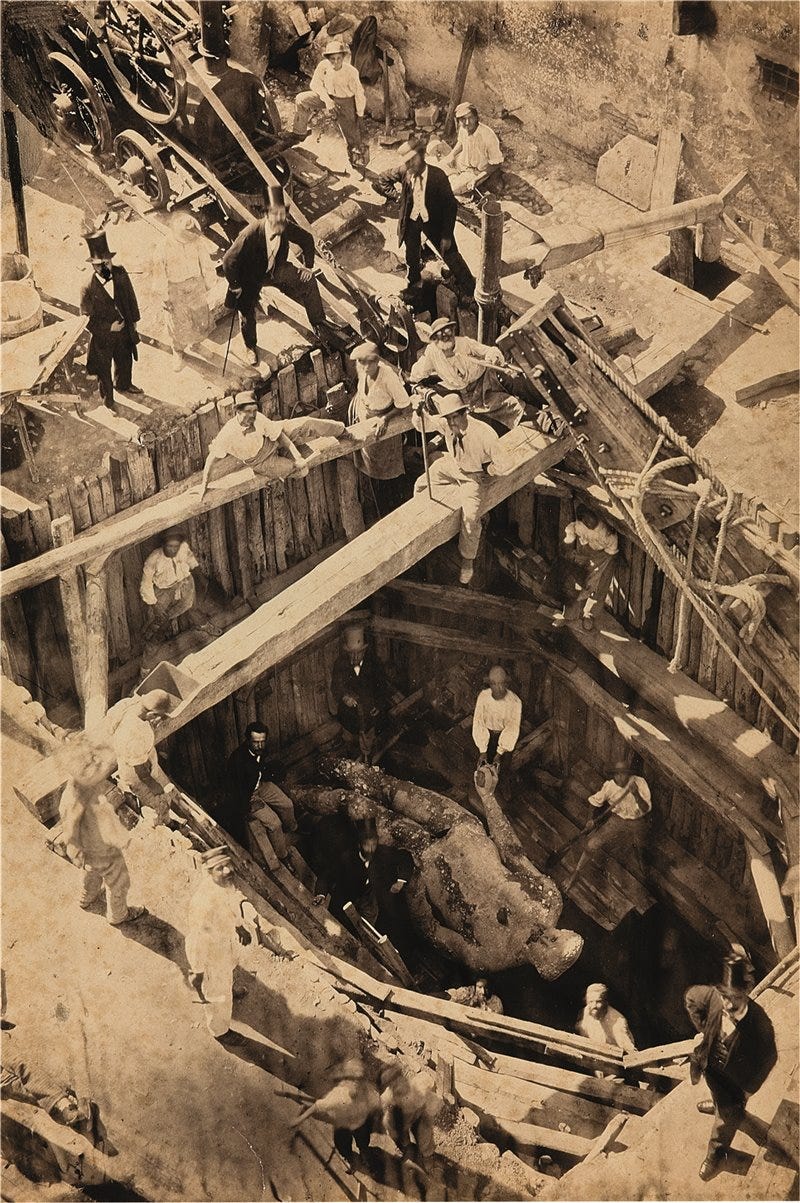
Photo: Gioacchino Altobelli | Comune di Roma
The statue is known today as the Hercules Mastai Righetti, after the surname of the Pope who bought it, Pius IX, and that of the man who sold it to him.
It had been carefully laid in the pit and covered with travertine slabs, carrying the letters F C S, later interpreted as F(ulgur) C(onditum) S(ummanium). The Vatican Museums record also notes that the statue had been buried together with the remains of a lamb.
As at Villa Adriana, the S on the slab that covered the Hercules would point to Summanus, the god who hurled lightning at night.
What the bidental in the Amphitheater at Villa Adriana holds is still to be worked out.
Perhaps we will find out soon.
Read also

Bibliography
Pliny the Elder, Naturalis Historia, II.138–145.
J. Linderski, “Bidental,” in S. Hornblower, A. Spawforth, E. Eidinow (eds.), The Oxford Classical Dictionary, 4th ed., Oxford University Press, 2012, p. 231; online version updated 2021.
D. Manconi, S. Spiganti, “Un fulgur conditum a Todi (Umbria),” OTIVM. Archeologia e Cultura del Mondo Antico 3 (2017), pp. 1–40.
Musei Vaticani, L’Ercole Mastai: dal ritrovamento ai restauri, giornata di studio, 3 December 2024.
Musei Vaticani, “Hercules Mastai,” Museo Pio Clementino, online collection catalogue.
Well, I never! Utterly fascinating.⚡️